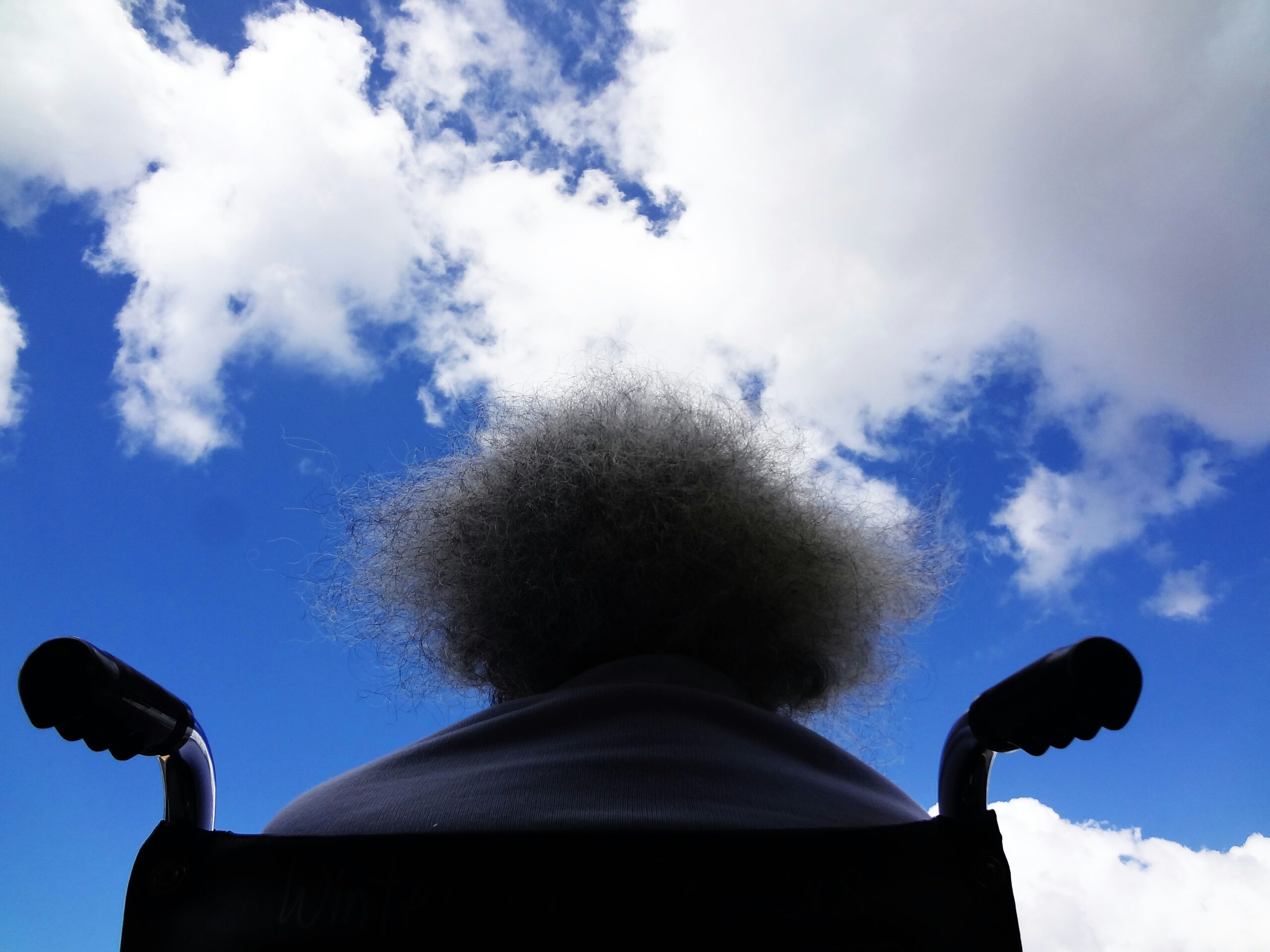
The year I lost my ability to walk was the same year my family became fitness enthusiasts. While my body was betraying me, theirs were thriving — reaching new heights of strength and endurance. My mother was planning her next marathon, my aunt bolting out the door to her step class, and my cousins took turns borrowing each other’s bicycles to ride through the summer. They spoke in a language of muscle recovery, elevation gain, and personal bests.
I felt like a mourner at a wedding, grieving the loss of movement while they celebrated theirs.
I tried to share their enthusiasm, to cheer them on as they crossed finish lines and swapped training tips, but there was an undeniable chasm between us. Their bodies were something to push, to strengthen, to test against nature’s elements. Mine had become something to accommodate, to negotiate with, to grieve. I loved them and their victories, but each new win was like a mirror reflecting my own stillness.
Hydrotherapy was first prescribed as a response to the pain and musculoskeletal changes that come when Spinal Muscular Atrophy progresses. The tightness in my hips, the aching in my back, the way my body curled in on itself in rebellion against its own weakening muscles — these were symptoms to be managed, not experiences to be enjoyed. I had never intended to love hydrotherapy. It was medicine, not passion.
But something in me refused to surrender to that stillness. I had already resigned myself to being a full-time wheelchair user, but I wasn’t about to let motion become a memory. If I could not move the way I once did, I would learn to move differently — and define strength on my own terms. I began to measure endurance through my Apple Watch, to track resilience in minutes spent suspended in water, to turn adaptation into its own form of athleticism. The longing to move — to keep moving — became my resistance, not my grief. Without that longing, hydrotherapy might have turned into another well-intentioned remedy I perform rather than embody. Instead, it became the space where I shaped stillness into something voluntary, something mine.
My hydrotherapy appointments take place before the group sessions. These classes bring together young and old, people with all kinds of mobility impairments, each of us arriving with different challenges but drawn together by a similar optimism. We are unified by our instructor, a soft but fierce Belgian physiotherapist whose love language is shuffling a Spotify playlist that drifts between country, the blues, and everything in between.
Her voice is gentle but commanding, urging us to move, stretch, push just a little further. It is the kind of discipline that feels like care, the kind of encouragement that makes you want to meet her expectations even on the days when movement feels impossible.
On my second week she asked me to rotate through a sequence: from standing, to knees-to-chest, to lying on my stomach, then back to my knees, to kicking the wall, and up to standing again. When she realised how determined I was, her assistance became no more than a soft noodle pressed beneath my palms. Later, she stopped helping altogether — sometimes sitting at the edge of the pool, legs dangling, watching me tread water continuously for my cool-down. “Do you need a noodle?” she’d call, half-teasing. I rarely did.
Today, the water cradles me in its cool embrace, its buoyancy a gentle betrayal of gravity’s unforgiving pull. For the first time in a long time, I am standing. Well, sort of. Elvis croons through a small Bose speaker, his voice drenched in the aching heart of the blues. His drawl stretches over the melody, each note curling into a wistful sigh — the kind that speaks of love lost, of roads not taken, of things slipping just beyond reach. The longing in his voice settles into my bones, resonating with something deep and unspoken within me.
I was in my early twenties when I stopped walking. Spinal Muscular Atrophy Type 3 is a thief that takes in slow, deliberate increments. It stole my strength first, then my balance, until one day, my legs simply refused to carry me. The world shifted: what was once instinctive — standing, walking, running — became an exercise in grief. I spent months grappling with the realisation that my body had permanently changed, that I would now have to navigate the world on a chair with four wheels.
The wheelchair came with its own set of freedoms and confinements. I learned to move differently, to take up space in ways I had never considered before. But even as I mastered the mechanics of my new reality, a phantom ache persisted, an echo of what once was. It was not just movement I missed, but the identity tied to it — the rhythm of footsteps, the arbitrary way I rose from a chair, the unconscious shifting of weight from one foot to the other.
When my physician first suggested water therapy, I hesitated. The idea of walking again, even within the controlled confines of a pool, felt like both a cruel reminder and an alluring mirage. But grief has a strange way of coexisting with possibility. And so, I stepped — or rather, floated — into the water.
In the beginning, there was fear — of falling, of failure, of stirring up a grief I had spent years containing. But the water does not judge. It does not demand explanations. It simply holds you. And so, I kept coming back. Week after week, step after step, I reclaimed something I thought had been lost forever.
Now, I run. Not with the same carefree Spinal Muscular Atrophy-defying speed of my childhood, not with the same land-bound ease. But in this pool, I propel myself forward, my legs remembering their purpose, my body rewriting its own narrative. Today, I run in circles, the resistance of the water making each motion both effortful and effortless.
My mother waits at the edge of the pool with a towel, her eyes filled with something I can only describe as wonder. She has watched me grieve, watched me struggle, and now, she watches me move. Later, in the car, she drives with one hand on the wheel and passes me her energy bar with the other so I can open it for her — an exchange so ordinary it feels sacred. Then, matter-of-factly, she says, “Andazi ke okba uzakwenza kanjani for ezi-appointments zakho kodwa mna ndizakubuya kula veki.” I’m not sure how you’ll manage your own logistics, but I won’t be back until that outer week.
Her words land somewhere between instruction and trust. The old ache rises, brief but familiar. Then, as I glance down at my legs — legs that have, today, run through water — I feel something else. Not envy. Not grief. Just knowing.
I am moving forward, too.
Image by James Williams Written by Thembelihle Ngcai | Edited by Megan Ross
Thembelihle Ngcai is a South African writer and a recognised public figure in disability advocacy and policy spaces across South Africa.
She is a published and anthologised writer whose work spans personal essay, cultural criticism, and public commentary, with a focus on disability, access, and social justice. Her essays blend lived experience with social critique, resisting narratives of tragedy or inspiration in favour of complexity, dignity, and truth.
Alongside her writing, Ngcai contributes to national conversations on disability inclusion through advocacy, public speaking, and policy engagement, working at the intersection of storytelling, power, and social change.
As a queer person, I had my concerns about having a child. When I first found out I was pregnant, which I doubted was possible given my PCOS (polycystic ovary syndrome) being that — due to my PCOS, I was unaware that there was even a possibility of me having any children of my own. So it never crossed my mind.
The year I lost my ability to walk was the same year my family became fitness enthusiasts. While my body was betraying me, theirs were thriving — reaching new heights of strength and endurance.
These poems are inspired by my partner and the ins and outs of our queer relationship. I write with the hope of capturing fleeting moments of our lives together.